Product
 Brand
Brand Articles
 Tools
Tools
What Size Wire for a 60 Amp Breaker? The Complete NEC Guide
This technical guide provides electricians, contractors, and DIY installers with the National Electrical Code (NEC) standards for selecting the correct 60-amp wire size based on material, insulation, and installation conditions.
Selecting the correct wire size for a 60-amp circuit breaker requires balancing conductor material, insulation temperature ratings, and voltage drop over distance. Under modern NEC standards, a standard 60-amp circuit requires either 6 AWG copper wire (rated for 65 amps at 75°C) or 4 AWG aluminum wire (rated for 65 amps at 75°C). However, using Type NM-B (Romex) cable restricts the circuit to a 55-amp limit due to thermal constraints, necessitating an upsize to 4 AWG copper for a full 60-amp load.
Wiring a 60-amp circuit for a subpanel, double oven, or EV charger isn't as simple as grabbing the first spool of 6 AWG wire you see. A single mistake with wire insulation types can lead to melted terminals or a failed electrical inspection. This guide breaks down NEC Table 310.16 ampacity ratings, the critical differences between copper and aluminum, continuous load rules, and how to adjust your wire size for long distances.
Conductor Material Requirements for 60-Amp Circuits
A 60-amp circuit breaker requires a minimum of 6 AWG copper wire with THHN/THWN-2 insulation or 4 AWG aluminum wire to comply with National Electrical Code (NEC) ampacity standards.
Copper Wire Requirements (6 AWG vs. 4 AWG)
According to recent 2026 benchmarks and the National Electrical Code (NEC) Table 310.16, 6 AWG copper wire with THHN/THWN-2 insulation is rated for 65 amps at 75°C. It is also rated for 75 amps at 90°C, though terminal lugs on residential equipment typically limit the usable rating to the 75°C column. Consequently, 6 AWG copper THHN is the correct, code-compliant choice for a standard 60-amp breaker under normal operating conditions.
With 6 AWG copper THHN, you can safely deliver up to 14,400 watts of power on a 240V circuit (or 15,600 watts at its maximum 65-amp rating). This capacity allows a homeowner to power a heavy-duty residential subpanel or a high-speed electric vehicle (EV) charger without risking thermal degradation of the conductor.
The "Aluminum Penalty" (4 AWG Minimum)
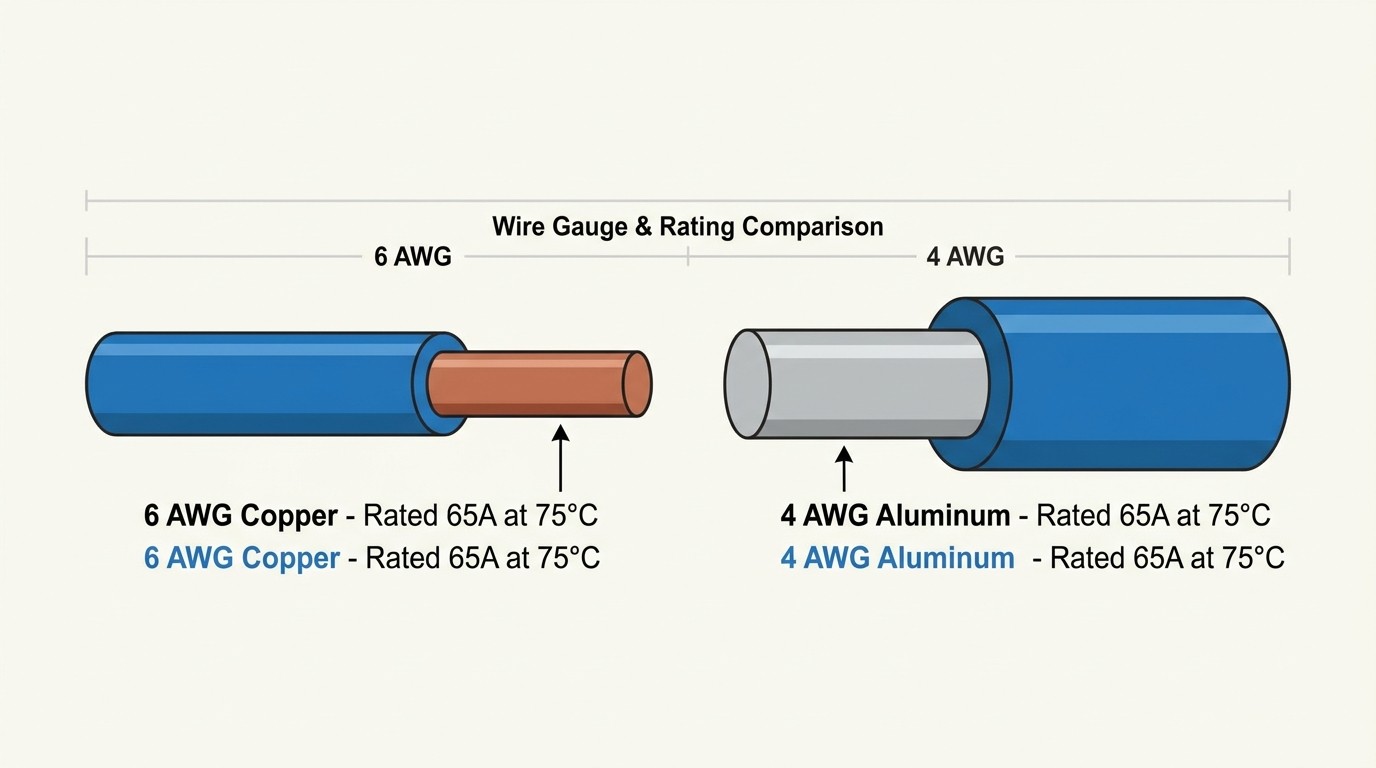
While copper is highly conductive, aluminum is frequently selected for larger feeder runs due to its lower material cost. However, aluminum is an inferior conductor of electricity compared to copper. Experts point out that if you opt for aluminum wire over copper to save money, you must step the size of the wire up one gauge. Specifically, while #6 copper is rated for 50–60 amps, #6 aluminum is only rated for 40 amps at 75°C (and 40 amps at 60°C). Therefore, to safely support a 60-amp circuit, you must step up to 4 AWG aluminum, which is rated for 65 amps at 75°C.
For budget-conscious installers running long feeder lines to a detached garage, aluminum wire remains the stronger choice because it offers a significantly lower material cost per foot. However, for indoor residential applications with tight conduit space, copper wire offers a more compact and highly conductive path that simplifies routing.
220V/240V Circuits: Do You Need /2 or /3 Wire?
When wiring heavy-duty 220V/240V appliances, installers must determine whether the load requires a neutral conductor. In visual training diagrams, experts map out a literal translation guide separating theoretical ratings from practical applications. On the theoretical side, a standard rule of thumb is "COPPER: 50-60A = #6". However, when connecting this to heavy-duty household items like ranges or double ovens, the practical application requires a deeper look at insulation types and conductor counts.
While smaller residential wires feature distinct color-coded jackets at big-box hardware stores (14/2 is white, 12/2 is yellow, and 10-gauge is orange), #6 wire for 60-amp circuits is typically black and sold by the foot rather than in pre-colored Romex spools.
Experts warn that heavy 220V appliances, such as certain large dryers or ranges, explicitly require a neutral wire to power internal 120V components (like timers or lights). This means purchasing "/3" wire (such as 6/3 copper) which contains two hot conductors, a neutral, and a ground, rather than "/2" wire which lacks the neutral. Conversely, pure 240V loads like EV chargers or water heaters do not utilize 120V control circuits and therefore only require "/2" wire (two hots and a ground).
Temperature Column Restrictions and Ampacity Ratings
Conductor ampacity is not a fixed value; it is determined by the temperature rating of the wire's insulation and the terminal connections at each end of the circuit.
Understanding NEC Table 310.16 Temperature Columns
NEC Table 310.16 is divided into three temperature columns: 60°C, 75°C, and 90°C. These columns represent the maximum temperature the wire insulation can safely withstand before degrading. While modern wires like THHN are rated for 90°C, the circuit's overall ampacity is limited by the lowest temperature rating of any component in the system, including the circuit breaker terminals.
The NM-B (Romex) Restriction (NEC 334.80)
A common point of confusion among DIY installers is the rating of Type NM-B (Romex) cable. NEC Article 334.80 legally restricts Type NM-B to the 60°C temperature column for ampacity calculations, regardless of whether the physical wire inside is rated for 90°C. According to Table 310.16, 6 AWG copper at 60°C is only rated for 55 amps.
Consequently, 6 AWG Romex cannot legally or safely support a full 60-amp load. If you install 6 AWG Romex on a 60-amp breaker for an appliance drawing more than 55 amps, you risk overheating the cable, melting the outer sheath, and causing a structural fire. To run a full 60-amp load using Romex, you must upsize to 4 AWG copper Romex, which is rated for 70 amps in the 60°C column (and can thus safely handle 60 amps).
Users on community forums often report failing rough-in inspections because they ran 6/2 or 6/3 NM-B Romex for a 60-amp EV charger. While many guides suggest that any 6 AWG copper wire is suitable for a 60-amp breaker, professional installations actually require THHN wire in conduit or an upsized 4 AWG copper Romex cable because NM-B is thermally limited to 55 amps.
Circuit Breaker Terminal Ratings
Under NEC 110.14(C), the temperature rating of the wire must match or exceed the temperature rating of the equipment terminals. Most modern residential 60-amp circuit breakers feature terminals rated for 75°C. This allows installers to use the 75°C column of Table 310.16 when wiring with individual THHN/THWN-2 conductors in conduit, making 6 AWG copper (rated for 65 amps) fully compliant.
Standard residential breakers use air and arc chutes to extinguish electrical arcs during overcurrent events (for a detailed breakdown of these mechanisms, see Circuit Breaker: Working Principle, Types and Structure). Conversely, high-voltage industrial applications require a Vacuum Circuit Breaker to extinguish arcs within a sealed vacuum chamber, where terminal temperatures and arc suppression demands are significantly higher.
Additionally, installers must consider the "Weakest Link" rule of fusing. When dealing with high-draw appliances that feature an external disconnect (such as a central air conditioning unit), the circuit's actual rating is determined by its lowest fused point. Having a massive 100-amp breaker at the main panel does not matter if the local disconnect is fused at 30 amps; the circuit operates strictly as a 30-amp circuit.
Continuous Load Calculations and the 80 Percent Rule
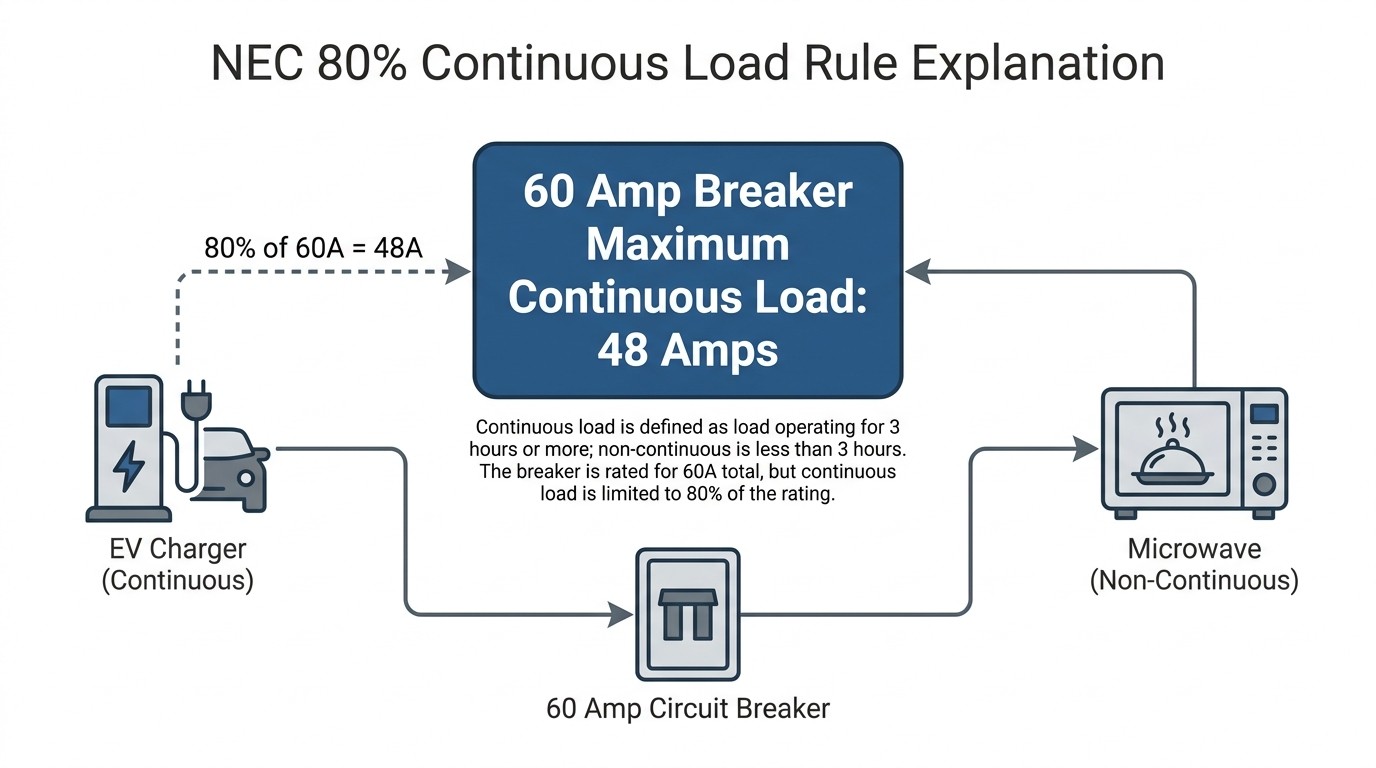
Continuous electrical loads running for three hours or more must not exceed 80% of the circuit breaker's rated capacity, limiting a 60-amp breaker to a maximum continuous draw of 48 amps.
What Qualifies as a Continuous Load?
The NEC defines a continuous load as any electrical load where the maximum current is expected to continue for three hours or more. Common residential examples include electric vehicle (EV) chargers, electric baseboard heaters, and subpanels feeding multiple continuous appliances. Non-continuous loads, such as microwaves or waste disposers, operate for short bursts and can utilize the full rating of the breaker.
Calculating the 48-Amp Limit
Under NEC 210.19(A)(1) and 210.20(A), the branch circuit conductors and overcurrent protective devices must be sized at no less than 125% of the continuous load. Mathematically, this is equivalent to the 80% rule:
Maximum Continuous Load = 60 A × 0.80 = 48 A
Consequently, a 60-amp breaker can only support a continuous draw of exactly 48 amps. This is why high-speed EV chargers (such as a Tesla Wall Connector) are configured to draw a maximum of 48 amps when connected to a 60-amp breaker.
📺 "Confused About Wire & Breaker Sizes? Here's What You Need to Know!"
Experts emphasize that the physical nameplate rating stamped on the appliance is the ultimate authority. As noted in professional training:
"You need to look on a nameplate rating all the time to see what it draws... to see what the amperage is. That's what you look for, the amperage... and that will determine your wire size."
Furthermore, high-draw appliances must be installed on dedicated circuits. If you connect a 60-amp subpanel or a heavy-duty range to a circuit sharing any other load, you will inevitably experience nuisance tripping and localized thermal stress.
Distance and Voltage Drop: When to Upsize Your Wire
Running a 60-amp circuit over long distances introduces electrical resistance, which causes a drop in voltage and reduces appliance efficiency.
The 3% Voltage Drop Recommendation
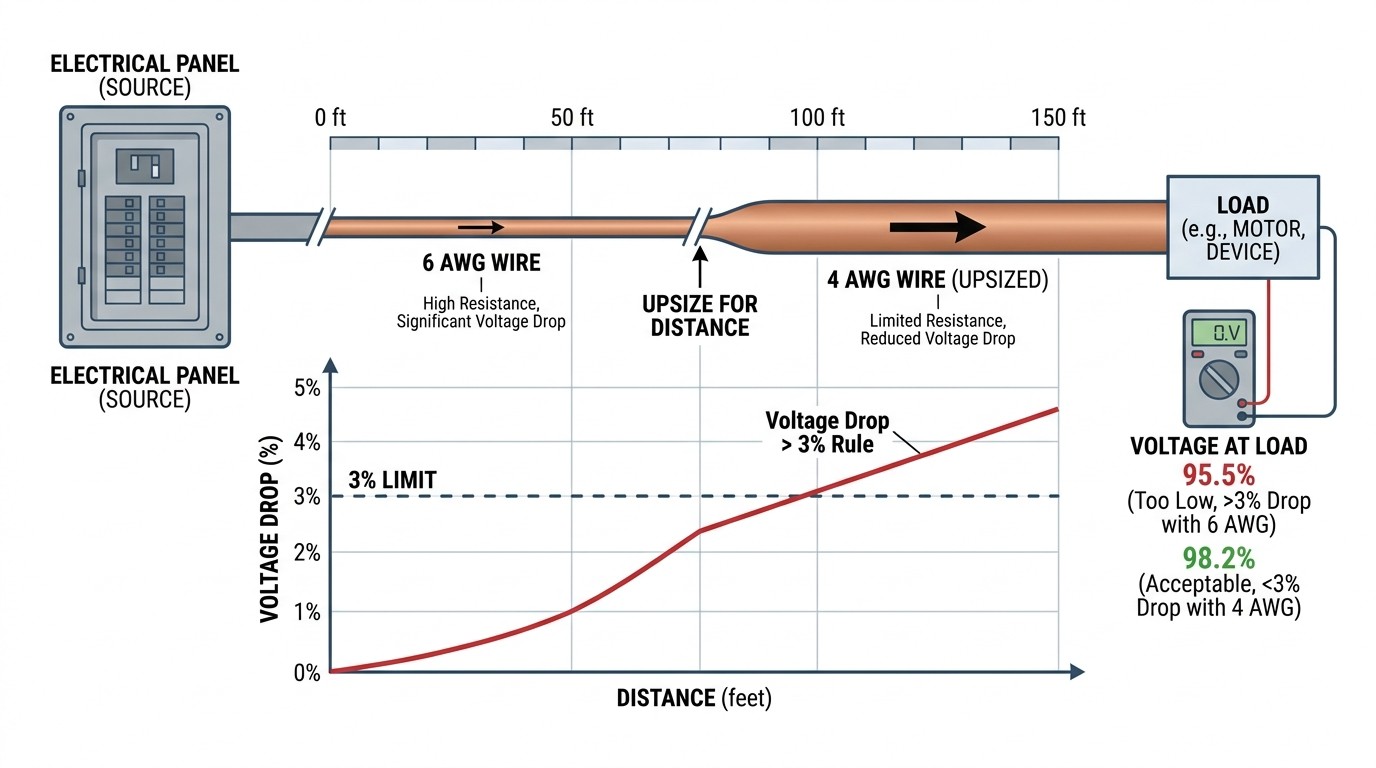
While the NEC does not strictly mandate voltage drop limits for all branch circuits, Informational Note 2 in NEC 210.19(A) recommends keeping voltage drop under 3% at the farthest outlet for maximum operating efficiency. For a standard 240V circuit, a 3% drop limits the voltage loss to 7.2V, meaning the voltage at the appliance should not fall below 232.8V.
For a 60-amp load, a standard 6 AWG copper wire will exceed this 3% threshold at approximately 100 feet. If you are running a feeder line to a detached garage or a backyard workshop located 150 to 200 feet away, you must upsize the conductors to 4 AWG or 2 AWG copper (or 2 AWG or 1/0 AWG aluminum) to compensate for the resistance.
How to Safely Splice Upsized Wires
Upsizing your conductors for distance introduces a practical installation challenge: large wires (like 2 AWG) often will not fit into the terminal lugs of a standard 60-amp circuit breaker, which are typically designed to accept a maximum of 6 AWG or 4 AWG wire.
To resolve this, installers must transition the larger wire to a smaller, code-compliant gauge inside a junction box just before entering the electrical panel. This transition requires heavy-duty insulated inline connectors or reducing butt splices. For a comprehensive review of the mechanical and thermal performance of these connectors, consult How Top Wire Splice Connector Brands Stack Up This Year.
Grounding Wire Size for a 60 Amp Circuit
A safe electrical installation requires a properly sized Equipment Grounding Conductor (EGC) to provide a low-impedance path for fault currents.
Standard EGC Sizing (NEC Table 250.122)
The minimum size for an equipment grounding conductor is determined by the rating of the overcurrent protective device (the breaker) ahead of the circuit. According to NEC Table 250.122, a 60-amp circuit requires a minimum grounding wire size of:
10 AWG Copper
8 AWG Aluminum
These sizes ensure that in the event of a short circuit, the ground wire can safely carry the fault current back to the panel to trip the breaker instantly without melting.
The Proportional Upsizing Rule
A common mistake that leads to failed electrical inspections is neglecting NEC 250.122(B). This rule states that if the ungrounded (hot) conductors are upsized in size (circular mil area) to compensate for voltage drop over long distances, the equipment grounding conductor must be upsized proportionally.
For example, if you upsize your hot conductors from 6 AWG copper (26,240 circular mils) to 4 AWG copper (41,740 circular mils) for a long run, you have increased the conductor area by approximately 59%. Consequently, you must upsize your 10 AWG copper ground wire (10,380 circular mils) by the same percentage, which requires stepping up to an 8 AWG copper grounding conductor.
60 Amp Wire Size Quick Reference Matrix
| Wire Material | Insulation Type | NEC Temp Column | Required Gauge for 60A | Maximum Continuous Load (80%) | Best Application |
|---|---|---|---|---|---|
| Copper | THHN / THWN-2 | 75°C | 6 AWG | 48 Amps | Conduit runs, subpanels, EV chargers |
| Copper | NM-B (Romex) | 60°C | 4 AWG (6 AWG is limited to 55A) | 44 Amps (on 4 AWG) | Indoor residential branch circuits |
| Aluminum | THHN / XHHW | 75°C | 4 AWG | 48 Amps | Long feeder runs, detached garages |
| Aluminum | SE / USE Cable | 75°C | 4 AWG | 48 Amps | Residential service entrance feeders |
Summary and Next Steps
When planning a 60-amp electrical installation, 6 AWG copper THHN or 4 AWG aluminum wire are the standard choices for conduit runs. However, if you are using NM-B Romex, you must upsize to 4 AWG copper due to the 60°C thermal restriction. Always limit continuous loads to 48 amps, and remember to upsize both your hot and ground wires if your run exceeds 100 feet.
Because local municipalities frequently adopt different editions of the National Electrical Code or enforce local amendments, you should always consult your local building department or a licensed electrical contractor before purchasing materials or beginning physical installation.
Frequently Asked Questions
Can I use 6 AWG wire for a 60 amp breaker?
Yes, but only if the wire is rated for at least 75°C (such as THHN/THWN-2 in conduit) and the terminal connections are rated for 75°C. If you are using Type NM-B (Romex) cable, 6 AWG is restricted to 55 amps, meaning you must upsize to 4 AWG copper to support a full 60-amp load.
Can I use 4 AWG aluminum for a 60 amp subpanel?
Yes. Under NEC Table 310.16, 4 AWG aluminum wire is rated for 65 amps in the 75°C column, making it fully compliant and highly cost-effective for feeding a 60-amp subpanel.
What size conduit do I need for 60 amp wire?
For three 6 AWG THHN copper conductors (two hots, one neutral) and one 10 AWG copper ground, a minimum of 1-inch Schedule 40 PVC or 3/4-inch EMT conduit is required to comply with standard conduit fill limits (40% max fill for three or more conductors).
Will a 60 amp breaker trip if the wire is too small?
No. A circuit breaker only detects overcurrent (amperage) and short circuits; it cannot detect if the physical wire connected to it is undersized. If the wire is too small, it will overheat and potentially melt its insulation, creating a severe fire hazard long before the breaker trips.
Do I need to upsize my wire for a 60 amp EV charger?
If the EV charger draws 48 amps continuously, a 60-amp breaker is required. If the run is under 100 feet, standard 6 AWG copper THHN in conduit is sufficient. If the run exceeds 100 feet, you should upsize to 4 AWG copper to prevent voltage drop and localized heating.
 UTMEL
UTMEL
We are the professional distributor of electronic components, providing a large variety of products to save you a lot of time, effort, and cost with our efficient self-customized service. careful order preparation fast delivery service
 What Size Wire for a 60 Amp Breaker? The Complete NEC GuideUTMEL22 May 20266971
Selecting the right wire size for a 60-amp breaker requires evaluating conductor materials, insulation, and distance. While 6 AWG copper THHN or 4 AWG aluminum in conduit is standard, NM-B Romex limits 6 AWG to 55 amps, requiring 4 AWG copper. Additionally, installers must account for continuous load limits, ground wire sizing, and voltage drop over long runs.
Read More What is Surge?UTMEL09 February 20227205
Hello everyone, I am Rose. Today I will introduce surge to you. Surge is an overvoltage that occurs suddenly and surpasses the typical operating voltage. A surge is a brief wave of current, voltage, or power in a circuit, in general.
Read More Surge Protection Devices (SPD): The Complete 2025 GuideUTMEL25 December 202528950
A surge protection device (SPD), also called a surge protector, is an electronic device that provides safety protection for various electronic equipment, instruments, and communication lines. When a spike current or voltage is suddenly generated in the electrical circuit or communication circuit due to external interference, the surge protection device can conduct and shunt in a very short time, so as to prevent the surge from damaging other equipment in the circuit.
Read More What is a Ground Fault Circuit Interrupter?UTMEL27 March 20255857
A ground fault circuit interrupter(GFCI) is an electrical device installed to protect against severe electric shocks. It can also reduce electrocutions, minimize electrical burns and shock injuries, and detect ground faults, and interrupts the flow of electric current.
Read More What is Vacuum Circuit Breaker?UTMEL12 October 202110406
Hello, I am Rose. Welcome to the new post today. The name "vacuum circuit breaker" comes from the fact that both the arc extinguishing medium and the insulating medium of the contact gap after arc extinguishing are high vacuum; it has the advantages of compact size, light weight, frequent operation, and no arc extinguishing maintenance. This article introduces basis knowledge about vacuum circuit breaker.
Read More
Subscribe to Utmel !
![1N965BE3/TR]() 1N965BE3/TR
1N965BE3/TRMicrochip Technology
![1N5532BUR-1/TR]() 1N5532BUR-1/TR
1N5532BUR-1/TRMicrochip Technology
![R21100F]() R21100F
R21100FMicrochip Technology
![JANTXV1N4627DUR-1/TR]() JANTXV1N4627DUR-1/TR
JANTXV1N4627DUR-1/TRMicrochip Technology
![CDLL4930A/TR]() CDLL4930A/TR
CDLL4930A/TRMicrochip Technology
![1N6842/TR]() 1N6842/TR
1N6842/TRMicrochip Technology
![1N4748AGE3]() 1N4748AGE3
1N4748AGE3Microchip Technology
![1N6627/TR]() 1N6627/TR
1N6627/TRMicrochip Technology
![CDLL4899A/TR]() CDLL4899A/TR
CDLL4899A/TRMicrochip Technology
![CDLL4916/TR]() CDLL4916/TR
CDLL4916/TRMicrochip Technology